Learning Outcomes:
i. Identify key adaptations of angiosperms that enable them to thrive on land.
ii. Describe the role of roots, stems, leaves, flowers, and fruits in the life cycle of angiosperms and their contributions to terrestrial adaptation.
iii. Explain how angiosperms have overcome challenges such as water conservation, reproduction, and dispersal in terrestrial environments.
Introduction:
Angiosperms, or flowering plants, are the most diverse and successful group of land plants, with over 350,000 species. Their remarkable success can be attributed to a suite of adaptations that allow them to thrive in a wide range of terrestrial environments.
i. Adaptations for Water Conservation:
Roots: Angiosperms possess extensive root systems that anchor the plant in the soil and absorb water and nutrients. This adaptation is crucial for survival in drier environments.
Cuticle: The surfaces of leaves and stems are covered with a waxy cuticle, which prevents excessive water loss through evaporation. This adaptation is particularly important in arid regions.
Stomata: Stomata are tiny pores on the underside of leaves that regulate gas exchange (carbon dioxide and oxygen) between the plant and the atmosphere. They open and close in response to environmental cues, conserving water when necessary.
ii. Adaptations for Reproduction:
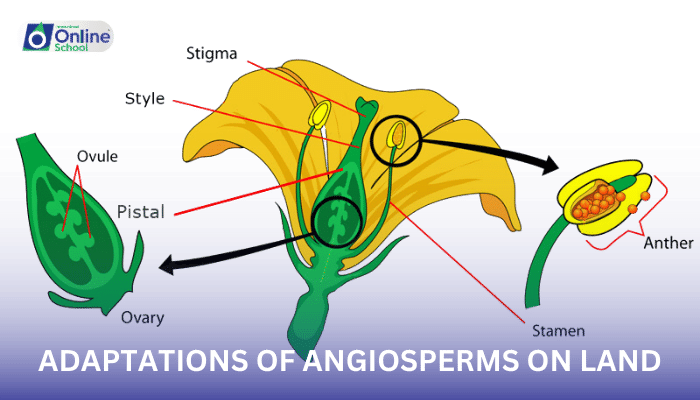
Flowers: Flowers are specialized structures that attract pollinators, such as insects, birds, or bats, and facilitate the transfer of pollen grains from the male anthers to the female stigma. This adaptation enables sexual reproduction without the need for water.
Double Fertilization: Angiosperms undergo double fertilization, a unique process where one sperm fertilizes the egg cell to create an embryo, and a second sperm fuses with a different structure to form a nutrient-rich endosperm. This ensures adequate nourishment for the developing embryo.
Fruits: Fruits are modified ovaries that enclose and protect the developing seeds. They aid in seed dispersal by attracting animals that consume the fruit and deposit the seeds elsewhere.
iii. Adaptations for Dispersal:
Fruits: Fruits, with their fleshy or dry structures, attract animals that disperse the seeds. For example, berries attract birds, while nuts attract squirrels and rodents.
Seed Adaptations: Some seeds have unique structures that facilitate dispersal by wind or water. For instance, dandelions have feathery appendages that allow them to float on the wind, while coconuts have a hard, waterproof coat that enables them to disperse by water currents.
Vegetative Propagation: Angiosperms can propagate vegetatively, producing new plants from various vegetative organs, such as stems, roots, or leaves. This method of asexual reproduction allows them to expand their populations without the need for seeds.
Angiosperms have conquered the land through a remarkable array of adaptations that enable them to conserve water, reproduce efficiently, and disperse their offspring. Their extensive root systems, waxy cuticles, stomata, flowers, fruits, and diverse seed structures demonstrate their resilience and adaptability in a wide range of terrestrial environments. Their success has not only contributed to the diversity of plant life but also provided essential resources for human societies, from food and medicine to timber and fibers.
